When a growing B2B SaaS platform launches a complex new API, enterprise feature set, or compliance module, operational friction shifts to the helpdesk. Client-facing teams face an immediate surge in nuanced configuration queries. Without a dedicated technical support context engine, agents routinely escalate these tickets, pulling core developers out of critical sprint cycles to answer repetitive setup questions.
This systemic drain dilutes engineering capacity and slows down product delivery timelines. Enterprise operations require a structured mechanism to capture product telemetry and source documentation, delivering immediate resolutions to frontline support teams without engineering intervention.
Executive dashboard
Target infrastructure
High-ticket Vertical B2B SaaS (Compliance, MedTech, Enterprise Supply Chain)
The core problem
Complex API or product releases trigger ticket surges that pull developers from deep work.
Primary benchmark
Reclaims 20% of engineering billable time while reducing Average Resolution Time (ART).
The challenge
For a B2B SaaS company scaling between 20 and 80 employees, cross-departmental dependency represents a major operational vulnerability. When a support team of 10 agents manages clients running highly specialized compliance or medical data pipelines, standard documentation is rarely sufficient. Frontline staff lack the architectural visibility required to troubleshoot complex execution errors independently.
As a result, your engineering team of 20 developers becomes a secondary support tier. Every technical escalation forces a developer to halt their current code sprint, review log files, and draft a custom explanation. This constant context switching costs your business hours of high-value engineering capacity every single week.
The financial penalty extends beyond lost developer hours. When Tier 1 support agents wait on engineering input, your Average Resolution Time stretches from minutes to days. This delay degrades the customer experience precisely when enterprise clients require absolute stability during new feature adoption.
The SovereignBrain framework
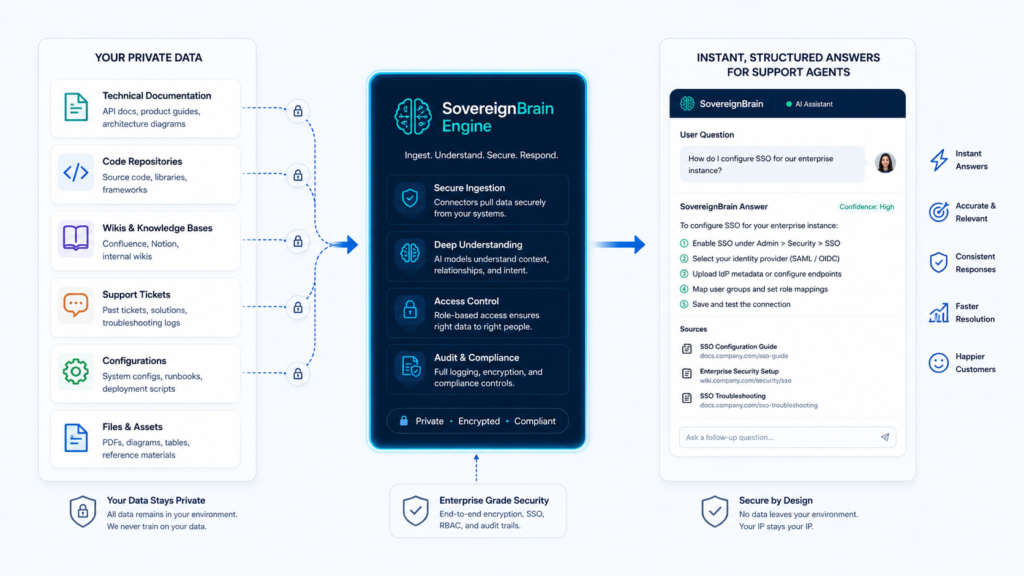
The SovereignBrain™ Fully Managed Done-For-You (DFY) Context Engine resolves this bottleneck by creating an autonomous repository of your platform’s entire operational logic. Instead of relying on static internal wikis, the system continuously indexes product requirements, API payloads, compliance documentation, and historical developer Slack conversations.
Enterprise data security and context isolation
Our architecture prioritizes absolute data isolation. The platform operates within a sandboxed environment, ensuring that your proprietary source code, internal schemas, and sensitive customer configurations remain fully protected.
Reducing escalation via context-aware automation
When an enterprise client submits a ticket regarding a complex integration failure, the engine evaluates the precise technical context. It searches the indexed product logic to provide support agents with the exact solution, including required code parameters or database conditions. Frontline teams resolve tickets independently, and developers stay focused on the core product roadmap.
Quantifying the core benchmarks
Deploying a structured framework changes the core metrics of your customer success and engineering organizations. The table below details the performance shift when moving from unoptimized knowledge silos to a managed technical support context engine.
| Operational metric category | Baseline architecture | Post-deployment architecture | Systemic value justification |
| Resource allocation | High-friction manual retrieval | 20% engineering time reclaimed | Reclaims skilled staff capacity for critical engineering tasks. |
| Resolution velocity | Delayed / High ART | Compressed / Low ART | Drops Average Resolution Time across all core touchpoints. |
| Implementation risk | High upfront capital expenditure | If it’s not working, you don’t paying. | Eliminates adoption friction via zero-risk validation models. |
Long-Term Enterprise Predictability
Resolving immediate ticket backlogs provides an instant operational relief, but the long-term benefit centers on institutional knowledge protection. In tech-enabled services and SaaS platforms, losing a senior engineer often means losing the undocumented logic behind a core system feature.
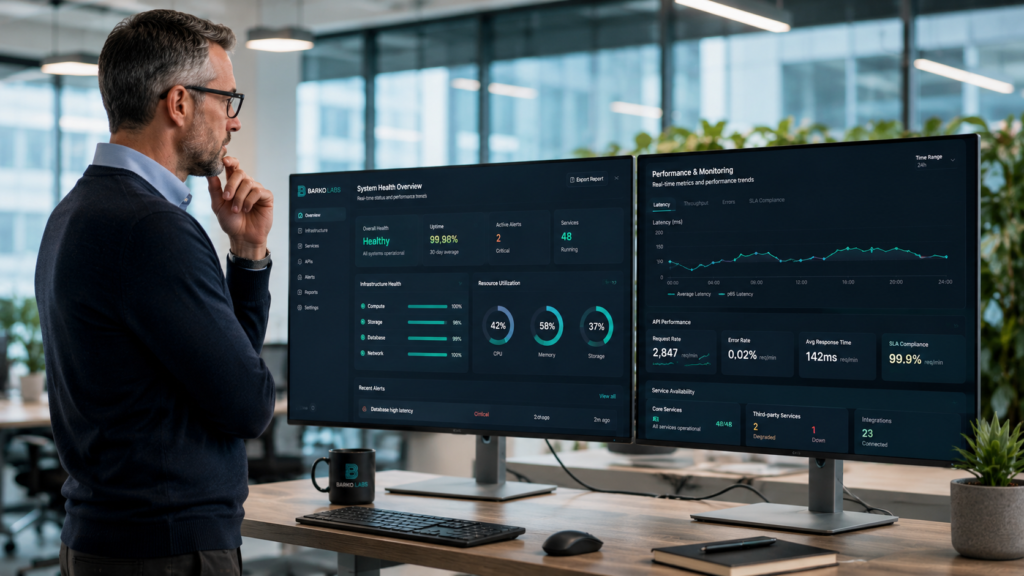
Centralizing this information within an operational context layer protects your business from turnover risks. Newly hired support agents become productive faster because the engine guides them through complex technical resolutions without requiring extensive training. Your entire operation gains predictable margins, faster support delivery, and uninterrupted product development cycles.