Every hour your tier 3 engineering staff spends digging through unindexed product documentation, regulatory compliance updates, or legacy support tickets is an hour stolen from your core product roadmap. For enterprise platforms operating in high-ticket verticals, this informational friction translates directly to bloated operational expenses and degraded customer satisfaction.
Executive dashboard
Target infrastructure
High-ticket Vertical B2B SaaS (Compliance, MedTech, and Enterprise Supply Chain Infrastructure)
The core problem
Technical support managers face escalating agent burnout and high average resolution times due to scattered, highly complex technical documentation.
Primary benchmark
Reclaims 20% of engineering and agent billable time while compressing Average Resolution Time (ART).
The challenge
Managing a helpdesk for complex enterprise systems like MedTech or supply chain software requires agents to parse highly specific variables under strict time constraints. When a priority ticket arrives, the actual diagnostic work rarely takes up the majority of the timeline.
Instead, the primary drain on your budget is the search for context. Agents bounce between disparate internal wikis, old Slack threads, and closed Jira tickets to verify how a specific compliance module behaves under precise configurations.
This manual asset retrieval creates an expensive operational bottleneck. Senior engineers are regularly pulled away from product development to assist tier 1 and tier 2 agents with repetitive technical clarifications. As your client base scales, your support overhead grows linearly, eroding gross margins and driving up your Average Resolution Time (ART).
The SovereignBrain framework
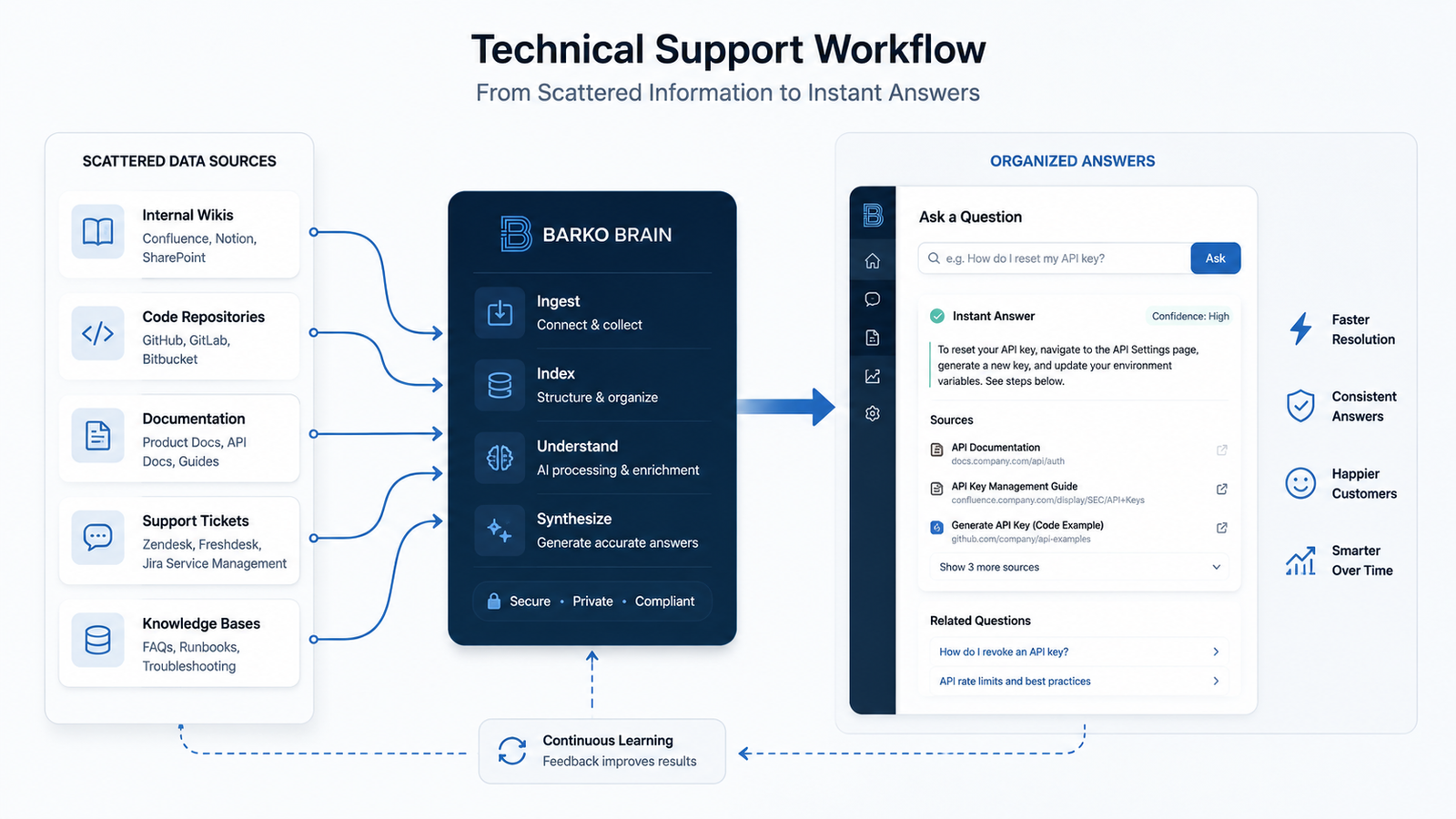
Resolving this operational friction requires shifting from static documentation repositories to a dynamic system built around technical support automation for B2B SaaS platforms. The SovereignBrain™ framework functions as an isolated, fully managed context engine that sits alongside your existing infrastructure to ingest, index, and surface critical platform data instantly.
Automated context ingestion
The platform establishes secure, continuous data pipelines into your internal knowledge silos. It systematically indexes technical specs, regulatory updates, and past resolutions without modifying your underlying database architecture.
Tiered support optimization
By serving as an authoritative, instantly searchable reference layer, the engine empowers tier 1 and tier 2 agents to resolve highly technical inquiries autonomously. This directly shields your senior engineering talent from low-level tickets.
Data security and compliance integrity
Operating within strict verticals like MedTech and compliance means data isolation is non-negotiable. SovereignBrain™ ensures all processed documentation remains strictly within secure resources, avoiding the data leakage risks inherent in public AI models.
Quantifying the core benchmarks
Deploying an enterprise-grade context layer replaces manual exploration with deterministic information retrieval. The operational shifts follow a clear, predictable trajectory:
| Operational metric category | Baseline architecture | Post-deployment architecture | Systemic value justification |
| Resource allocation | High-friction manual retrieval consumes engineering hours. | 20% reclaimed time across support and engineering staff. | Reclaims skilled staff capacity for critical engineering tasks and product roadmaps. |
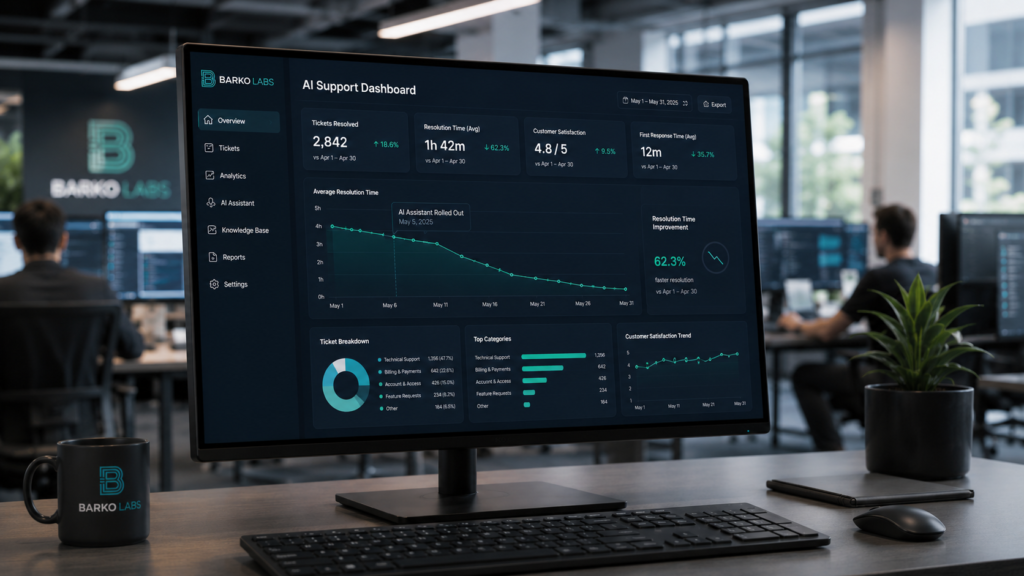
| Resolution velocity | Delayed / High ART due to prolonged internal research phases. | Compressed / Low ART via instantaneous context delivery. | Drops Average Resolution Time across all core touchpoints, raising client retention. |
| Implementation risk | High upfront capital expenditure and prolonged setup timelines. | If it’s not working, you don’t paying. | Eliminates adoption friction via zero-risk validation models and a Pre-Contract Viability Check. |
The macro financial impact
Optimizing your helpdesk workflows provides long-term strategic benefits that extend far beyond immediate quarterly metrics. By documenting and centralizing operational expertise within an automated framework, your enterprise insulates itself against knowledge loss when key staff members transition out of the company.
Furthermore, onboarding timelines for new customer success agents are substantially shortened. Rather than requiring months of specialized product training to master complex compliance or supply chain edge cases, new hires can leverage the context engine to find verified system behaviors from day one. This structural predictability allows your B2B SaaS organization to scale its user base confidently without requiring a corresponding linear increase in support headcount.