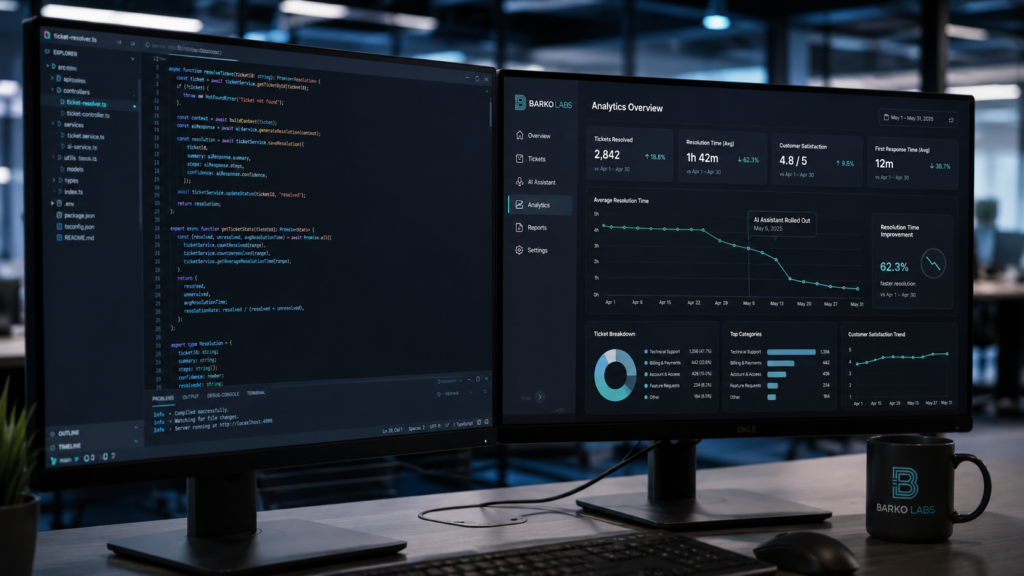
Executive dashboard
Target infrastructure
High-ticket Vertical B2B SaaS (Compliance, MedTech, and Enterprise Supply
Chain Infrastructure)
The core problem
Highly technical tier-3 support tickets consume high-value engineering hours due to fragmented operational context.
The business outcome
Reclaims 20% of engineering billable time and compresses Average
Resolution Time (ART).
The Invisible Drain
Fragmented knowledge and skyrocketing resolution times
For technical support and helpdesk managers operating within mission-critical verticals like MedTech, compliance software, and global supply chain systems, the daily baseline is defined by complexity. When a tier-3 ticket escalates, it rarely stems from a simple user error. Instead, it involves deep architecture questions, regulatory alignment anomalies, or multi-party API synchronization failures.
The core bottleneck is not a lack of staff competence, but a severe fragmentation of operational data. Highly trained engineers spend a significant portion of their shifts combing through disparate product documentation, historical code changes, and legacy ticket silos just to establish the baseline context required for troubleshooting.
This structural friction forces high-tier resources away from core product engineering, driving up operation costs. As technical issues sit in queues waiting for expert assessment, your average resolution time trends upward, directly exposing the enterprise to contractual service-level agreement penalties and erosion of client trust.
The SovereignBrain framework
The SovereignBrain Fully Managed Done-For-You Context Engine addresses this architectural flaw by establishing an autonomous, secure context layer across your existing operational infrastructure. Rather than forcing your engineering teams to learn a new interface, the system operates invisibly under the hood to ingest, clean, and map technical documentation in real time.
Secure ingestion and context isolation
In highly regulated fields such as compliance and medical software, data isolation is non-negotiable. SovereignBrain connects directly to internal wikis, continuous integration pipelines, and historical communication data through read-only secure connectors. The engine extracts semantic concepts without exposing sensitive customer databases or underlying source code to public networks.
Contextual synchronization a point-of-work
When a new ticket enters the queue, the Helpdesk Context Engine synthesizes the exact engineering history, code changes, and past resolutions relevant to that specific incident. It packages this intelligence instantly for the active support specialist, removing manual research steps and reducing the cognitive load required to initiate a remediation strategy.
Quantifying the core benchmarks
Deploying an enterprise-grade intelligence layer must reflect directly on the operational ledger. The table below outlines the shift from legacy support methodologies to an automated context model.
| Operational metric category | Baseline architecture | Post-deployment architecture | Systemic value justification |
| Resource allocation | High-friction manual documentation and code retrieval. | 20% engineering billable time reclaimed. | Reclaims skilled staff capacity for critical engineering and product roadmap development tasks. |
| Resolution velocity | Delayed triaging with high average resolution time. | Compressed average resolution time across all ticket categories. | Drops operational backlogs and stabilizes enterprise service-level agreement compliance. |
| Implementation risk | High upfront capital expenditure and long integration cycles. | If it’s not working, you don’t paying. | Eradicated client friction by ensuring seamless account transitions during employee turnover. |
The macro financial impact
Over a horizon of 6 to 12 months, structural context control fundamentally shifts the cost structure of high-ticket SaaS operations. As support documentation automatically maps to ongoing product updates, knowledge loss during staff transitions drops to zero. Technical helpdesk managers can onboard new personnel in days rather than months, ensuring consistent tier-3 resolution velocity regardless of changes in team composition.